
Walk down any candle aisle or scroll a maker's product page and you will run into the phrase phthalate-free. In 2026 it shows up in supplier catalogs, hobby forums, and on the back labels of small-batch candles. For shoppers it raises a fair question: what is actually in the wax, and does the label mean anything? For makers it raises a harder one: which oils still perform in soy wax once the phthalates are gone?
What follows is how the supply side looks right now, how to read a fragrance oil listing line by line, and how those choices show up in a finished candle on your shelf.
What "phthalate-free" means on a fragrance oil listing
Phthalates are a group of chemicals that have historically been used in fragrance formulas, often as solvents or fixatives that help a scent blend evenly and linger. A phthalate-free fragrance oil is one formulated without them. That is the entire claim. It says nothing about the rest of the formula, which is why the better suppliers now publish far more detail on each product page than they did a few years ago.
Lone Star Candle Supply is a useful example of how a modern listing reads. The company carries more than 200 phthalate-free fragrance oils, and every one is strength-tested for cold and hot throw before it joins the catalog. Each product page states the phthalate-free status alongside flash point, vanillin content, and soap and gel compatibility. That set of data points is what lets a maker decide whether an oil will behave in a particular wax, a soap loaf, or a gel application before spending money on a bottle that turns out wrong.
Why reformulation took years, not months
Removing phthalates is not a matter of swapping one ingredient on a label. CandleScience describes its own transition as a project that stretched over ten years, with at least 50 fragrances needing revision or replacement, hundreds of potential replacements rejected, and thousands of hours spent evaluating, testing, and reformulating. The company now states that its fragrance line is completely, totally, 100 percent phthalate-free.
That timeline explains why other suppliers phased the change in batches instead of all at once. One supplier announced it reformulated around 300 scents after hearing concerns from customers. A fragrance is a balance of top, middle, and base notes, and changing the solvent can shift how the whole blend behaves in wax. Every reformulation has to be tested again for how it smells when the candle is cold and how it smells while the wick is burning.
Photo by Mareefe on Pexels
Bottle to Flame — Cocktail Candle Collection



The two tests that decide whether an oil is worth buying
Cold throw is the scent you notice from an unlit candle sitting on a shelf. Hot throw is the scent released into the room while the candle burns. They are measured separately because an oil can be strong in one and weak in the other, and a candle that smells great in the jar but gives up nothing once lit is a disappointment no matter how clean the label looks.
This is where the phthalate question and the performance question meet. Lone Star strength-tests every phthalate-free oil for both cold and hot throw before it is added to the catalog, which is the standard to look for when you are comparing suppliers. If a listing does not mention throw testing at all, you are buying on hope.
Reading a fragrance oil product page in 2026
Most listings now carry a consistent set of fields. Knowing what each one does saves a lot of wasted wax.
- Phthalate-free status: either stated plainly or absent. If it is absent, ask before you buy.
- Flash point: reported on product pages and relevant to shipping and to how an oil behaves across different applications.
- Vanillin content: vanillin shows up in vanilla, bakery, and bourbon-style scents, and it can affect how a finished candle looks over time.
- Soap and gel compatibility: some oils work beautifully in wax but are not intended for cold process soap or gel.
- Strength testing: cold throw and hot throw results, if the supplier runs them.
None of these fields tells you whether you personally will like the scent. They tell you whether the oil is likely to behave the way you need it to. That is the part worth paying attention to before you commit to a full bottle.
Where phthalate-free oils are sold right now
The market has matured enough that phthalate-free is no longer a specialty corner of a catalog. It is a filter, and in some cases the whole lineup.
| Supplier | What the listing tells you |
|---|---|
| Lone Star Candle Supply | More than 200 phthalate-free oils, each strength-tested for cold and hot throw, with phthalate-free status, flash point, vanillin content, and soap and gel compatibility on every product page. Ships from CA, FL, IN, PA, and TX, with free pickup at all locations for qualifying orders. |
| Midwest Fragrance Company | Fragrance oils plus supplies, inspiration, and support aimed at makers who want to turn a passion into a business. |
| Wholesale Supplies Plus | A dedicated phthalate-free fragrance collection. |
| From Nature With Love | Categorized and alphabetized lists of phthalate-free fragrance oils, plus a running list of its top 25 best sellers during the past 90 days. |
| Rustic Strength | Product pages describe fragrance oils certified free of 624 carcinogens and 323 reproductive and developmental toxins, a step beyond phthalates alone. |
| CandleScience | States that its entire fragrance line is 100 percent phthalate-free after a decade-long reformulation effort. |
Photo by Yan Krukau on Pexels
What phthalate-free does not tell you
Discussions inside candle-making communities make the gap pretty clear. Makers ask which brands of fragrance oil are safest, or where to find oils that are phthalate and carcinogen free and still smell high quality. Phthalate-free answers one slice of that question, and only one. It does not mean an oil is essential oil only, it does not mean the fragrance is allergen free, and it does not automatically mean the product is "clean" under every definition someone might use.
Suppliers that go further say so directly. Rustic Strength describes its fragrance oils as 100 percent certified free of 624 carcinogens and 323 reproductive and developmental toxins. That is a separate claim from phthalate-free, and it deserves to be read on its own terms rather than folded into the same phrase. Whatever a brand states, the practical move is identical: read the product page carefully, and if a detail is missing, ask the supplier or the candle maker before you spend the money.
How this lands in a small-batch soy candle
At Bottle to Flame, phthalate-free fragrance oils are part of the build rather than a marketing add-on. The candles are hand-poured in Denver, Colorado, using soy wax and scents built with what the brand calls the Mixologist's Approach: base notes stand in for the spirit, middle notes for the sweetener, and top notes for the garnish. It is a way of structuring a scent the way a bartender structures a drink.
That approach shows up in how the individual candles are put together:
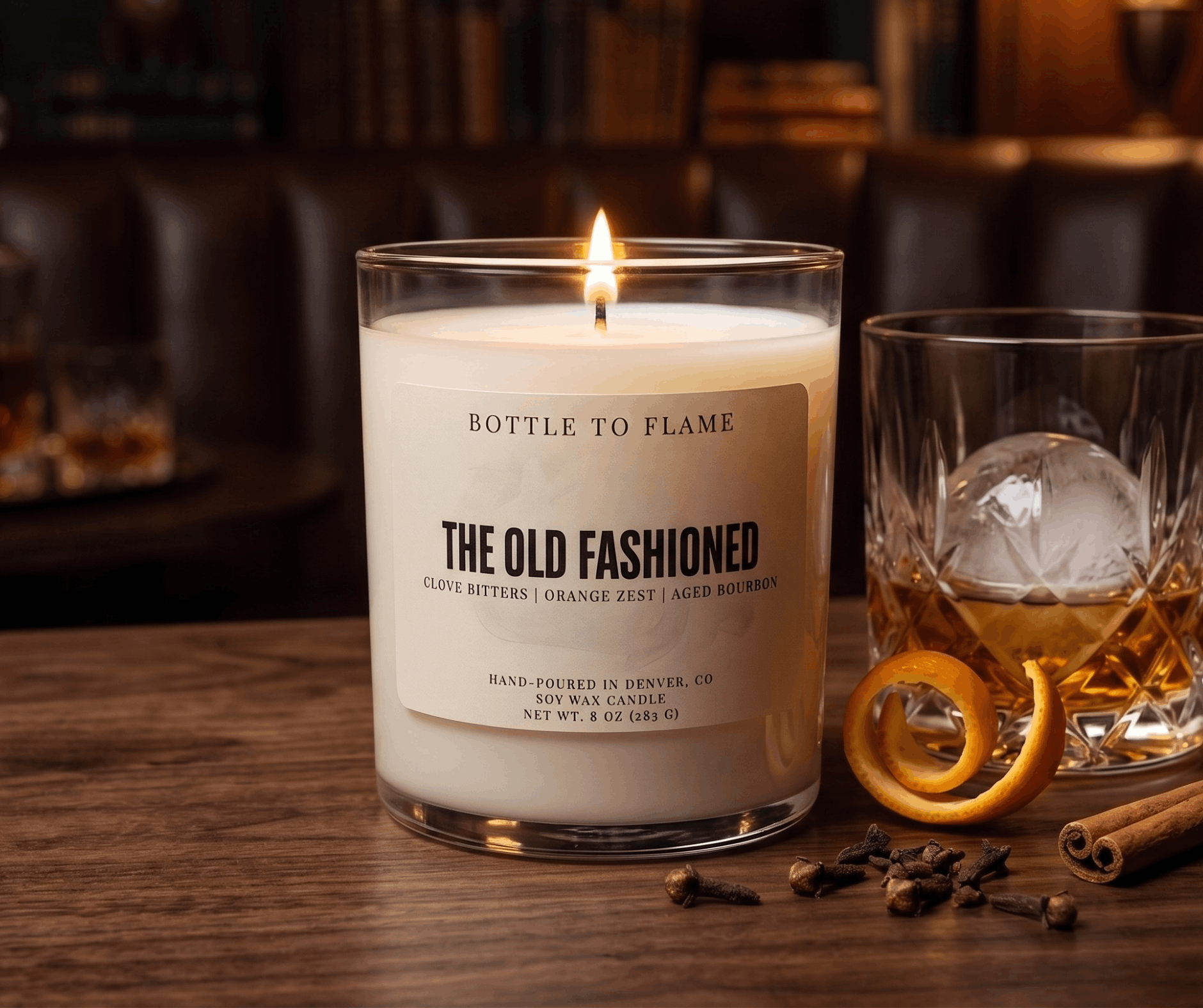
- The Old Fashioned, built on aged bourbon, clove bitters, muddled sugar, and worn leather for a dark, rich profile.
- The Celebratory Brunch, with lavender, champagne, pear blossom, and white florals for something crisp and uplifting.
- Sauvignon Blanc, leading with passion fruit, gooseberry, and green herbs for a bright, fresh pour.
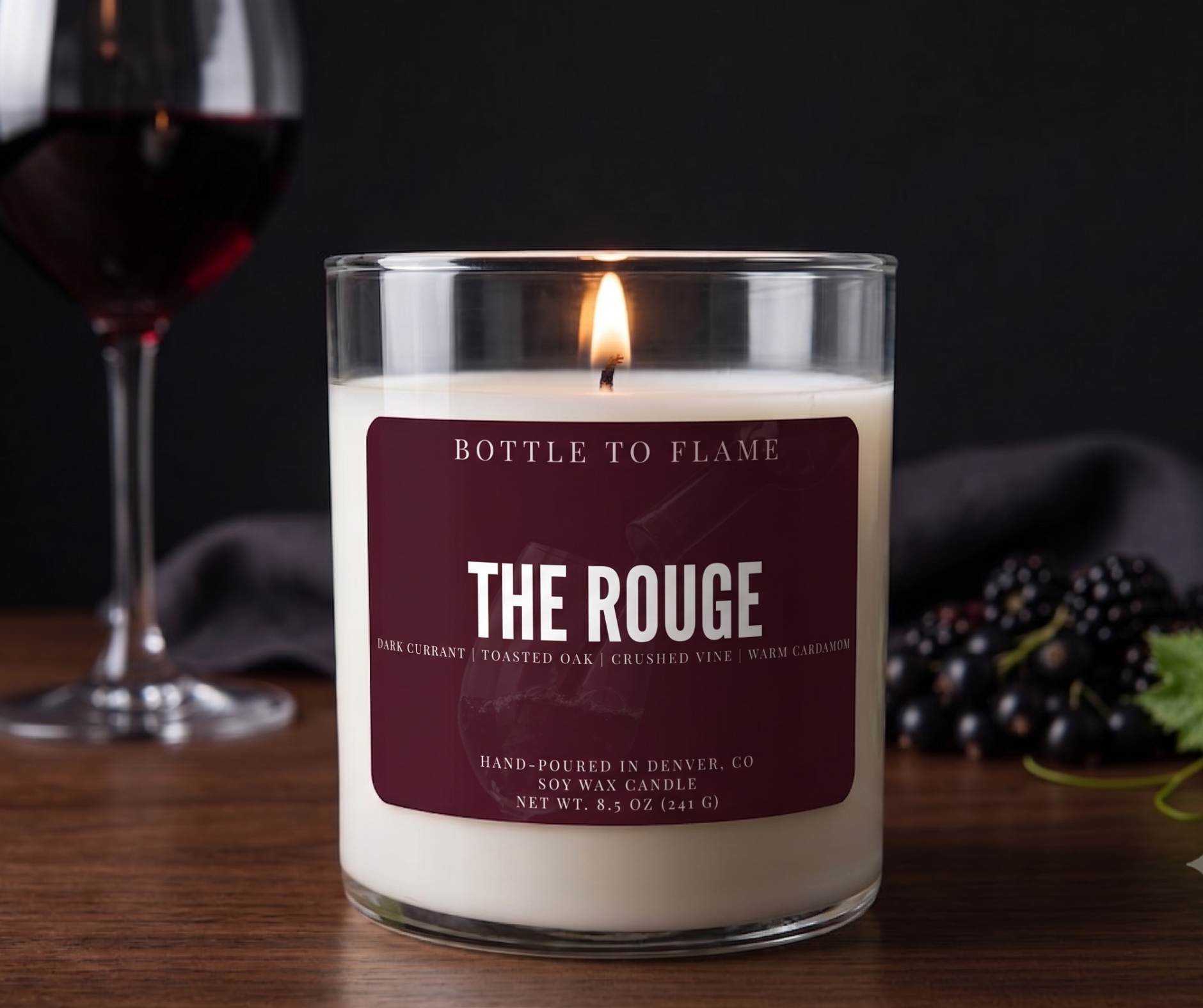
- Cabernet Sauvignon, with dark fruit and a cedar backbone for a bolder, more sophisticated burn.
Those scents are sold through bottletoflame.com and through the brand's Etsy shop. The details that matter for this conversation are simple: soy wax, phthalate-free oils, and a small-batch pour where each scent is built note by note rather than pulled off a generic list.
Photo by jose luis Umana on Pexels
What to ask before you buy a scented candle
A few direct questions separate a candle made with intention from one made with whatever was cheapest that month.
- Does the product page state that the fragrance oils are phthalate-free? If the phrase is missing, ask the maker directly.
- Which fragrance supplier does the maker buy from, and does that supplier publish test data?
- Was the oil tested for cold throw and hot throw, or only described in a marketing paragraph?
- If the maker makes broader claims about carcinogens or toxins, can they point to the certification behind the claim?
- What wax is used, and how does it interact with the oil concentration in that specific candle?
None of this requires a chemistry degree. It requires a maker who can answer plainly, which is usually a good sign about everything else in the jar.
Frequently Asked Questions
What does phthalate-free mean on a fragrance oil?
It means the oil was formulated without phthalates, a group of chemicals historically used in fragrances as solvents or fixatives. The claim covers that one class of ingredients and nothing more. It does not describe the rest of the formula, so if you want to know about allergens, vanillin content, or certification against other substances, you have to check the listing or ask the supplier directly.
Do phthalate-free fragrance oils have a weaker hot throw?
Not necessarily, but performance has to be tested rather than assumed. CandleScience spent a decade reformulating, rejecting hundreds of potential replacements along the way, which shows how much work goes into keeping a scent strong without phthalates. Suppliers like Lone Star Candle Supply strength-test every phthalate-free oil for both cold and hot throw before adding it to the catalog.
Are phthalate-free fragrance oils the same as essential oils?
No. They are different product categories. Essential oils are distilled from plant material, while fragrance oils are blended in a lab to reproduce a specific scent. Phthalate-free describes what has been left out of a fragrance oil rather than what it is made from. Some makers blend the two, but the phthalate-free label alone tells you nothing about essential oil content.
How can I tell if a candle uses phthalate-free fragrance oils?
Check the product page first, since many makers state it directly alongside wax type and scent notes. If the phrase is missing, ask the maker which fragrance supplier they use and whether that supplier publishes phthalate-free status on its product pages. Suppliers such as Wholesale Supplies Plus, From Nature With Love, and Midwest Fragrance Company all maintain phthalate-free collections you can verify.
Is phthalate-free the same as toxin-free?
No, and the two should not be used interchangeably. Phthalate-free refers to one class of chemicals. Some suppliers make broader claims, such as Rustic Strength describing its oils as certified free of 624 carcinogens and 323 reproductive and developmental toxins. Broader claims need their own documentation, so ask which certification is behind them before treating the label as a full safety guarantee.
Shop Bottle to Flame
Every candle is hand-poured in small batches in Denver using 100% soy wax and phthalate-free oils. The glass tumbler is refillable — send it back for 20% off your next pour. Free shipping on orders over $50.
The Old Fashioned — $34.99 • The Celebratory Brunch — $34.99 • The Blanc — $34.99 • The Rouge — $34.99 • Day & Night Set — $64.99